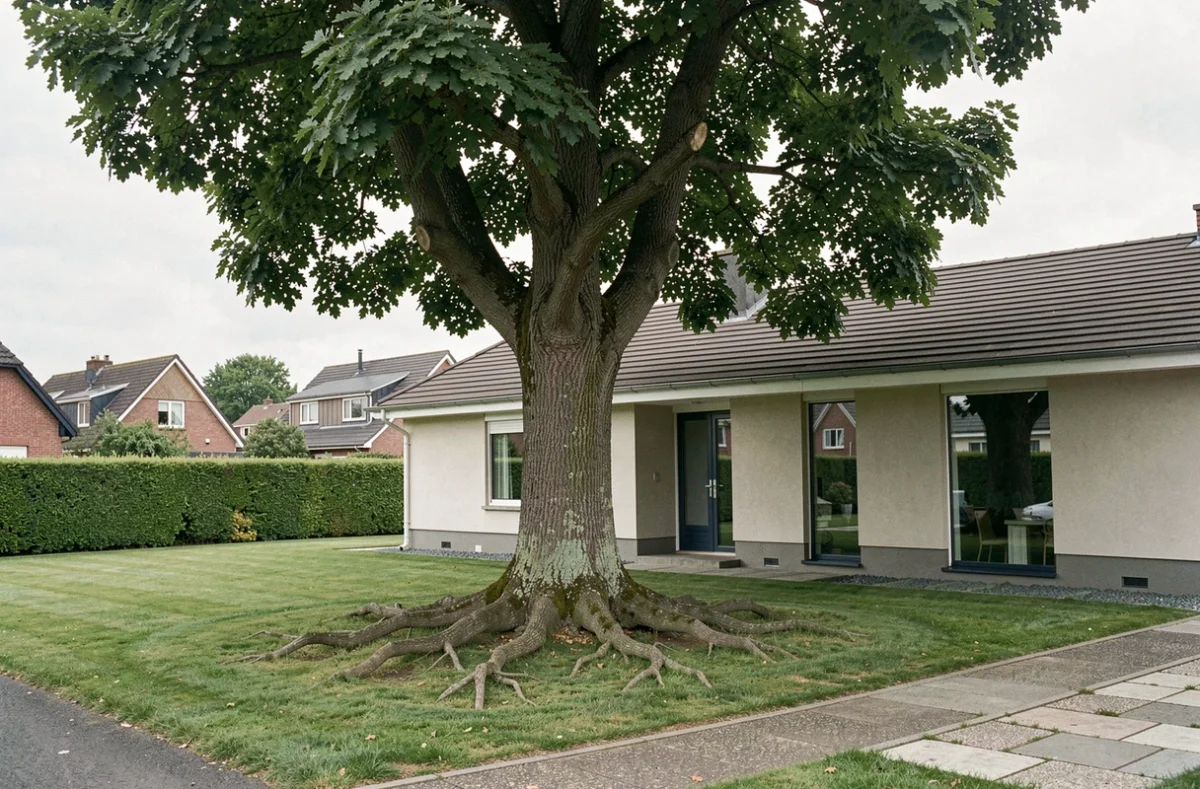
A tree planted too close to a facade can lift a terrace, crack a wall, or deprive a living room of light for years. The choice of species and location depends on three technical parameters: the type of root system, the mature size of the canopy, and the nature of the existing soil. Understanding these parameters before purchasing any plant from a nursery avoids costly corrections ten or fifteen years later.
Clay soil and shrink-swell: the first criterion to check
Before even browsing a catalog of species, you need to know the nature of the land. On clay soil sensitive to shrink-swell, a large tree amplifies moisture variations around the foundations. During dry periods, its roots draw residual water, the soil shrinks, and cracks appear in the masonry.
According to the site Notre-environnement.fr (updated on September 22, 2026), about 12 million homes in France are exposed to this phenomenon. Official recommendations advise keeping vegetation away from buildings, monitoring water leaks, and avoiding downspout discharges at the foot of walls.
Specifically, if your plot is in a medium or high exposure zone, favor trees with shallow and contained root development (Japanese maple, serviceberry) rather than species with powerful taproots like oak or walnut. To identify the exposure level of your land, consult the shrink-swell hazard map available on the BRGM website or inquire at your town hall.
To delve deeper into the topic of the ideal location, the gardening advice from Perspectives Jardin details the distances and suitable species according to the terrain configuration.
Legal planting distance: article 671 of the Civil Code and local rules
The planting distance concerns not only the facade of your house. Article 671 of the Civil Code sets a national framework: a tree intended to exceed 2 meters in height must be planted at least 2 meters from the boundary of the neighboring property. For a subject that will remain under 2 meters, the minimum setback drops to 50 centimeters. The measurement is taken from the center of the trunk.
This general framework can, however, be superseded by local provisions. A PLU, a subdivision regulation, or a recognized usage in the municipality may impose different distances, sometimes more restrictive. Before choosing a location, consult the urban planning documents at your town hall.
Another often overlooked point: if a branch or root extends over the neighboring property, the neighbor has the right to cut what crosses the boundary. This legally accepted action can destabilize the tree or compromise its health. Anticipating the mature spread avoids neighborhood conflicts as well as structural problems.
Root system and mature size: two criteria to filter species
A tree is chosen from the bottom (its roots) and from the top (its mature canopy). These two dimensions determine whether it will coexist without damage with a nearby structure.
Spreading, taproot, or fibrous roots
- Spreading roots extend on the surface, sometimes well beyond the canopy. Willows, poplars, and black locusts are known to lift pavements and infiltrate pipes. To be avoided in immediate proximity to a building.
- Taproots plunge vertically. They pose fewer problems on the surface, but on clay soil, they exacerbate drying out at depth. Oak and walnut fall into this category.
- Fibrous roots form a dense but shallow network. Japanese maple, star magnolia, or ornamental apple trees remain compact and tolerate relatively close planting to a terrace.
Height and spread of the mature canopy
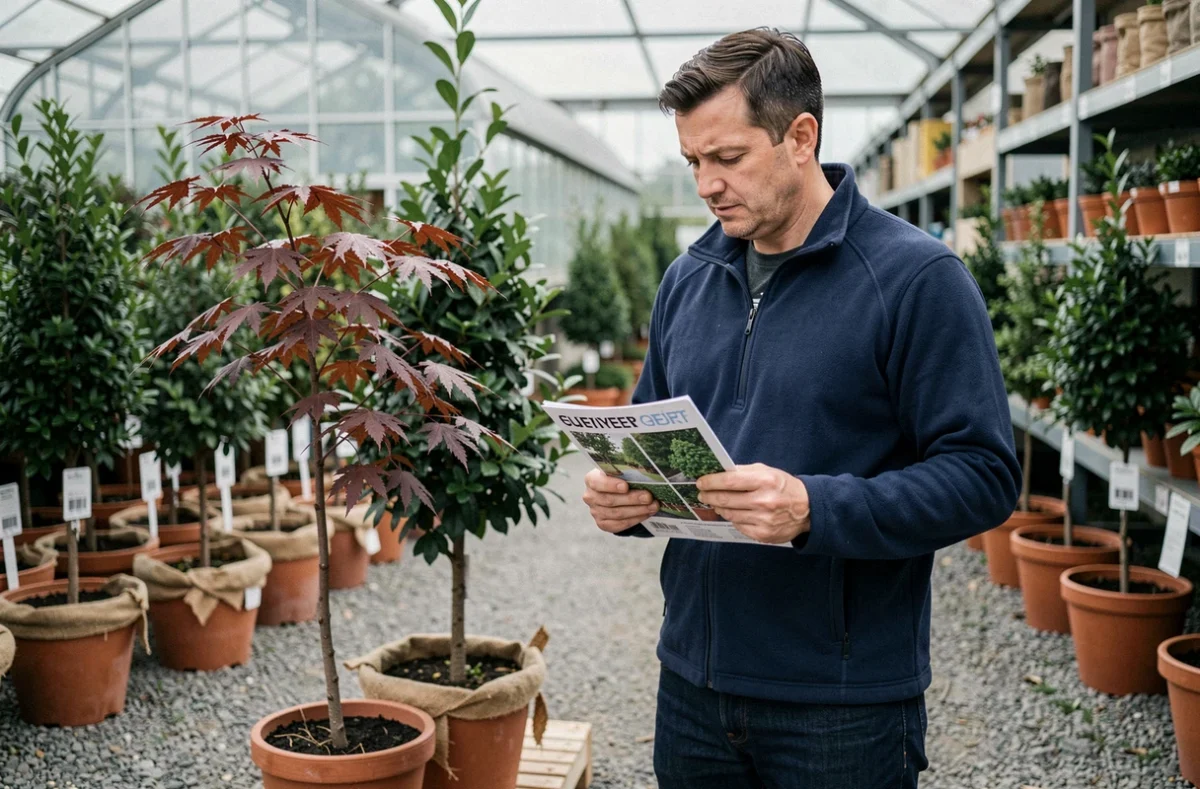
The small subject of one meter bought in a container can reach eight, ten, or even twenty meters depending on the species. It is not just the height that matters, but the ratio between height and crown width.
A ball-shaped catalpa (cultivar ‘Nana’) rarely exceeds four to five meters and maintains a compact form, making it suitable for small gardens. A Judas tree offers spectacular flowering in spring while remaining under six to eight meters. In contrast, a lime tree or a plane tree will take on a spread incompatible with proximity to a facade.
Foliage, shade, and maintenance: adapting the tree to the garden’s use
The choice between deciduous and evergreen foliage profoundly alters the daily experience. A deciduous tree allows winter light to pass into living spaces, a notable advantage for south-facing facades. In return, the falling leaves in autumn require regular cleaning of gutters and the terrace.
An evergreen (olive, tree-form photinia) provides a visual screen all year round but reduces sunlight in winter. The compromise depends on the orientation of the house and the desired function: summer shade, privacy screen, or simply an ornamental element.
- For summer shade on the terrace, a deciduous tree with a spreading crown (ball-shaped catalpa, sterile plane mulberry) is the most effective.
- For a screen all year round without excessive height, an olive or a bay laurel trained as a standard offers dense foliage with a low spread.
- For an ornamental garden with low maintenance, serviceberry combines spring flowering, discreet fruits, and autumn coloring without mandatory pruning.
The question of maintenance is not limited to leaf collection. Some fruit trees (cherry, plum) produce fruits that stain a light terrace. Others, like birch, release abundant pollen in spring. Evaluating these minor nuisances before planting simplifies life for the decades that follow.
Local climate and solar exposure: the final filter before planting
A species perfectly suited to a garden on the Atlantic coast may wither in a continental climate. The choice of tree must take into account the hardiness zone, local rainfall regime, and the exposure of the land.
A star magnolia withstands moderate winters but suffers from late frosts that scorch its flowers. An olive thrives in a Mediterranean climate but languishes north of the Loire without winter protection. Checking the hardiness claimed by the nursery and comparing it to the minimum temperatures recorded in your municipality remains the most reliable precaution.
The exposure of the location also plays a role. A tree planted on a north-facing facade will receive little direct sunlight: shade-tolerant species (Japanese maple, dogwood) will be more comfortable there than a full-sun tree like the almond tree. Cross-referencing the species’ hardiness with the actual sunlight of the planting spot allows for the elimination of unsuitable candidates without waiting for three seasons of disappointing growth.